Tuesday, July 08, 2008

Jaane Tu...ya jaane na & Love Story 2050: Movie Reviews

Yes, I cannot tell a lie - I saw both these movies back to back. Yes, voluntarily. No, you may not ask why. Anyways, on with the reviews.

JT...YJN is an insufferable bore of a movie. The story is cliched beyond belief and thanda like kulfi. You can see the end coming just by reading the tag-line of the movie, which in effect makes this movie an exercise in patience. Not that there isn't enough absurdity in this flick. For example, you meet Peachy and Pumpkin, the so-called world's coolest parents who want to get their daughter married off as soon as she finishes college. Then there's Aditi's brother who's a straight lift from Six Feet Under. Then there are all the ugly friends, the bad gujju caricatures, the absurdity that is the Ranjhaur ke Rathod, Arbaaz and his brother....the list just goes on. And it is so badly shot, so poorly plotted and so badly directed that Love Story 2050 comes as a breath of fresh air.

I have to admit - I loved this movie. The cinematography was top class, the special effects were mind blowing and it was full of lovely little ideas that kept one entertained through the film. Was there a story? Nope. However, it seems a little unfair to single out this one film for not having a story. Did Jodhaa Akbar have a story? Did Eklavya? Did JT...YJN? Then why is this suddenly a problem with LT2050? Did I mention that the special effects were mind blowing? They were better than any of the Star Wars. The lighting and textures were of jaw-dropping beauty. I was mightily impressed. Do go watch this even if it is just to see a landmark in Indian special effects.Not that this film doesn't have its share of problems but I found them very easy to forgive.

The show we went for was attended by 60 odd Prime Focus special effects people, in effect the heart and soul of this film and we cheered lustily with them at each explosion and each gorgeously raytraced vista of Mumbai. Nikhat Kazmi does these people a huge disservice when she calls them "picture postcards" and I hope this goes a little way towards setting the record straight.

Monday, June 16, 2008

The Wonder That Is Emacs

This post is for all you people in Linuxland who stare enviously (and furtively) at Mac users with their TextMate. I know you've seen all the screencasts with some geek with a MacBook and TextMate doing their nifty snippet things and going clickety clack on their white keyboards. Well, I know I have and I said, yeah emacs is cool and all but why can't I have some TextMate coolness? Then I remembered, what the fuck? this is emacs we're talking about. A quick search reveals that emacs has had html-helper-mode (i.e. snippets) from 19-fucking-95 when html was a baby. Even cooler? It was written by Marc Andreesen. A whole load of history to go with your editing too. Here are some good blogs to setup your emacs properly with python code-completion, etc. Python Programming in Emacs Emacs as a powerful Python IDE Don't forget the screencast. That one is from 2006. Does TextMate do subversion? No, I mean properly....

Wednesday, June 11, 2008

Aamir - Movie Review

As you may have noticed, Aamir is getting a lot of buzz in the press. For example, Taran Adarsh writes
Films like Aamir are more for the discerning audience, for the thinking viewer. It's a film that attacks your mind, rather than your heart. It's a film that pricks your conscience.
Not one of the reviewers will tell you about all the pitfalls of this movie - its meaninglessness and the utterly retrograde politics it represents. About the politics first - the whole movie is pure Muslim bashing. It's entire objective is to get you to see Muslims as dirty, filthy, uneducated, meat-eating paedophiles and druggies. Portraying Aamir as the "educated, moderate" Muslim only makes the contrast that much starker. It is true that Muslims are poor and uneducated. But so are Hindus. But oh, just you try making a film like this about the Hindus. The moral police will be out in force talking about hurt sentiments and what not. Yet, if Muslims protest it will all be oh, look at them, they're so touchy.

Anyone with even the first glimmer of Marxist ideology will see the situation of the unwashed masses as a deliberate result of the policies of the establishment. It is class warfare and religion is just a tool of oppression. Looking for the reasons for terrorism in shady underworld dons is like looking for the reasons for cholera in a puddle of watery shit. It is purely symptomatic of repression, poverty and exploitation. Had the film carried such a radical message, it would then have been possible for the absurd plot to recede to the background as a purely narrative device to bring the bourgeois protagonist in touch with the proletariat, for the terrorist to then make the point that the real enemy is neither Hindu nor Muslim but lies in the corruption of the State and the greed of the elites. There was a point in the film where it almost went that way. I thought the director had set up a nice dialectic with the whole "aadmi apni kismat khud likhta hai" setup, but oh the waste...now, that would have been a film. As it is, Aaamir has a meaningless plot full of holes and an absurd ending and it has absolutely no sympathy for human beings that are victims of the great political games. It almost seems like someone else (cough...Anurag...cough..cough...Kashyap..) directed the film from about halfway through the first half (enough with the running behind the taxi already!!)

Is Nikhat Kazmi a Muslim? Can even she not see this film for what it is? What's that paper she writes for again? And boy oh boy did she go out on a limb for RGV with this one...some excerpts for your reading pleasure

But like his father, he has the welfare of Maharashtra at his heart and is hell bent on giving his state the multi-national power project which the NRI business executive (Aishwarya Bachchan) would like to set up in India
His camera follows the angles it excels in, plastering the screen with extreme close-ups of his protagonists. Of course, it does help when the faces in full view are extremely emotive and reflect the myriad emotions of anger, pain, passion and revenge with a mere muscle flick.
It is too boring to review the whole movie. Pathetic depiction of the goons that pass for politicians around here. Can you imagine a film about a power project (we all know which one Ramu) without a single rupee note exchanging hands? The asslicking machine is already at warp5 captain....I cannae hold her no more....

Update: A discerning viewer pointed out the very insiduous assumption at work in the film i.e. that an educated Muslim will immediately seek to distance himself from the terrorists, which is to say that their anger is not justified. Is it not possible that an educated person will look back and say that yes, after decades of marginalisation, of persecution and of being terrorised their anger is indeed justified. That is not a possibility that is admitted. Like in a one-sided argument, the film never delves into the marginalisation and terrorisation of Muslims in India, even if only to reject this as a justification. The film seems to say that only lack of education is the reason behind their squalor and the terrorism in India, and in the same breath says that the onus to educate oneself lies with the individual, as though systems of control and subjugation of whoever, Muslims, dalits, etc. just do not exist, that there will never be the equality of opportunity without some semblance of equality in circumstances.

Saturday, June 07, 2008

Mike Miller - possibly the tastiest guitar player ever!!

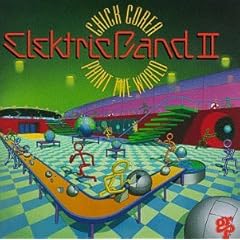
In 1993, Chick Corea put together the second version of his Elektric Band and recorded what has turned out to be one of my favourite jazz-fusion discs of all time - the seminal Paint The World (those who have been following this blog might remember this post). The lineup replaced uber-shredmeister Frank Gambale with the little known Mike Miller, a studio musician from the Los Angeles scene. I can still remember my jaw hitting the floor when Mike's music came pouring out of my speakers for the first time.

The first thing that strikes you about Mike is his tone - it is sharp and biting, and Mike really digs into your ears with his bluesy, ballsy playing throughout the album. The second thing you notice about him is his total control and very strong melodic sense. Of all the solos on the album, his are the most singable. Mike is the polar opposite of his predecessor in the band - he doesn't go in for very fast playing, choosing instead to let his phenomenal phrasing and evolved musical sense create their own mood. Mike's gutsy playing can be heard throughout the album as he solos or comps with some bizarre chords in that crunchy tone of his. In Tone Poem, he rips an absolutely phenomenal nylon-string solo, just for fun I guess. Some of his other standout solos are on CTA and The Ritual, while the sparring with Chick on the initial bars of Ished leave you in no doubt that this is a guitar player who has learnt the theory, mastered it and then chucked it out the window as he goes with his highly evolved musical gut. I won't waste any more time here, but what I will do instead is to leave you with a few samples of the masterful artist doing his thing.

Ritual solo.mp3 Space_solo.mp3 Tone Poem solo.mp3

Mike has a solo album out called Save The Moon. While the music on this album is a lot more laid back than Paint the World (Chick can get very complicated at times), it is still a whole album's worth of immersion in some wonderful guitar playing and you should totally buy it off emusic (or wherever) if you can.

Monday, May 26, 2008

The petrol subsidy must go.

Who is it helping the most? Large consumers of petrol. i.e. Ford Endeavour owners blasting the AC with a special power point for the computer. Or, people like my boss who drive a converted Merc van with a DVD player and a drinks cooler. These are not the people who need subsidies. These are the people that must be discouraged. A quick back of the envelope calculation reveals that petrol retails in India for $(3.78541178 * 54 /43) = $4.75 and change. This is second cheapest only after the great United States (outside of the major oil producing nations). It is a ridiculous number in a country where 99.3% of people DO NOT own cars. You might say that even motorcycles run on petrol to which I will say that the difference between 4-6 kpl in city traffic for a car and 60-70 kpl for a bike constitute two very different things in a family's budget. Or, one might sell three litres at the current price and everything above at exorbitant rates. A minor inconvenience for a biker - a major drag for car owners.

Indian oil companies are "weeks away from bankruptcy" (http://sify.com/finance/fullstory.php?id=14678154). Their failure will send cascading failures through the oil delivery system meaning that cooking gas, kerosene, diesel - the stuff that actually runs the country - might just become unavailable. This is hardly a price worth paying for the wellbeing of the chosen few.

More expensive petrol might actually allow the feedback mechanisms from peak oil to filter through to people's behaviour. Maybe if they drive less and we have less congestion on the roads, then we can possible even have decent standards of living in our cities. Perhaps revert some of that tarmac into basketball courts.

You can bet your ass that it is the country's car manufacturers who are "lobbying" for the maintenance of the status quo as regards petrol. They might as well not bother. As the rupee devalues against the dollar (a shocking occurence in its own right - possibly engineered by the textile and ITES companies), the price of petrol will put paid to their fancy advertising schemes and so on. Tata Nano might just become the "not-so-poor-man's-car" in the near future.

Look for more excitement on the energy front as the twin horsemen of inflation and supply constriction come riding out of the West.

Sunday, May 25, 2008

Peak Oil Hits the Mainstream

$135 a barrel. Headline news worldwide. World poised for the outbreak of fuel riots. All of America on the abyss. Is it really happening? It would be to boring to get into an introductory discussion about peak oil but the uninitiated can follow the discussion at http://theoildrum.com

Peak oil is an inevitability. Whether we are living through it at this very moment or not might even today be open to debate (or is it? http://europe.theoildrum.com/node/4018) but that the rate of flow of oil will drop below the constantly expanding demand for it seems to be a mathematical certainty. We have all heard the story of the ant and the grasshopper but can you believe that it seems to have had zero impact on all these responsible adults that are running the world? Here in India the increase in oil consumption is palpable. Landing in Mumbai the other day I saw for the first time a sky full of planes, circling. Airport buses with LCD televisions. Cavernous terminals with the air conditioning blasting, the doors open to 33 degree heat. All this wasn't here even just a few years ago and this is one of the poorest countries on the planet. How many more dinosaur bones can we burn before they finally give out? Are we building 13 tonne stone heads with the last of the wood?

To be quite honest, I find the cornucopian argument quite unfathomable. "Something will save us", they say, "It always has." Which would have been equivalent to driving while looking in the rear-view mirror except for the minor examples of the Easter Island and Aztec civilisations (and this from people who have even read Jared Diamond's Collapse). The history of the world is rife with examples of civilisations where "something" did not indeed arrive at the last minute and save everyone. To all the people still thinking about building spaceships to Mars I say this - pull your head out of your fucking arse and take a look around you.

Even if the high price of oil is indeed caused not by peak oil but by world's the collapsing financial systems, I posit that one of the reasons for this is purposeful demand destruction be people well aware of peak oil who want to preserve the precious stuff for the warplanes and the tanks. Hello prisonplanet.org !!

As the Coen brothers said - you can't stop what's coming. The mathematics of inflation and peak oil are very clear. The descent is inexorable. Then it accelerates. What can one do? Gather together. Play some music. Smoke a joint. Forgive your enemies. And your friends. And yourself. Re-evaluate. Re-connect.

We have enough aeroplanes. What we need is a new myth. A new heroism. A new culture.

Monday, May 05, 2008

Food riots and Energy as Money

It was jusgt a few days ago that I told someone - sometime before 2009 is over we will see extreme poverty being brought about by nothing more than a collapse of the world's monetary systems. Seems like it is coming to pass already.

GWB's recent comments regarding the alarming rise in food prices has sparked off quite a controversy in the papers here in India, as well as I suppose in China. Of course, Jairam Ramesh was right in retorting that this is just another example of his ignorance, which indeed it is. Had there been massive crop failures or some other event, it would even have made sense but in the absence of all these issues, simple rising of demand for meat, etc from India cannot explain a 200% increase in wheat prices and 100% increase in rice prices in such a short time. The massive diversion of cropland away from food to biofuels does play some part in the tragedy that is unfolding. Those of you who have faith in the free market and its ability to fix our looming energy crisis might pay attention to this, a good example of the so called free market completely fucking things up for everybody. Wheat prices Rice prices

What can, and does explain the alarming rise in prices is US Dollar inflation and rigidities in the real world that cannot keep pace with the changing value of money. Oil prices US Dollar

Now, some trader on Wall Street bidding on rice contracts, priced in USD, has changed the world for all the rice buyers whose national governments and central banks have a particular policy towards the US dollar. Regime's change painfully. Those who have built their lives on a particular regime will fight tooth and nail to preserve it, but like every other fiat currency, the fiat currencies of today and especially the most powerful US Dollar (or should we call it by its real name - the Federal Reserve Dollar) are beginning their inexorable decline to zero value and are causing untold misery along the way. It seems there is a limited amount of money you can push into the economy through subprime loans and HELOC extractions before people start wondering what it is that those dollars actually do.

So now we have a situation where the collapse of the worlds monetary systems is once again causing poverty where none existed. Even hallowed institutions like the World Bank are saying that all of Capitalism painstaking efforts at pulling millions out of poverty have suffered a huge setback with millions being pushed back into poverty because they were just too far away from the action - the action being the rapid and continuous devaluation of the world's reserve currency. Fools.

Sooner or later one must ask the question - what is money? I think we can answer this by describing the functions that money performs i.e a medium of exchange and a store of value. However, let us take a closer look at these functions and see whether our hallowed dollars and rupees do actually perform this function. Is the dollar a medium of exchange? Undoubtedly. You can buy bread, eggs, apartments for dollars. You accept dollars as payment because you are sure that somewhere down the road, someone else will accept dollars to provide you the things you need. A dollar, and all money, represents a claim on assets, on real things. From whence does this claim arise? Simply put - from propoganda and from the corecive power of the State. Can you think of another reason why you continue to accept dollars and rupees in exchange from your labour when the value of your assets changes so rapidly from day to day?

Is money a store of value? Let me ask you - is a lakh of rupees a lot of money? Can you remember a time when it was? How long ago was it? Your savings - what will they be worth when you retire? Is this fair? Here's another question to test your familiarity with that thing we call reality - is gold a currency because it is valuable, or is gold valuable because it is a currency? Leave your answers in the comments.

Most of you who read this will scoff. Don't worry - that is normal. For someone to suggest that Weimar hyperinflation could arise again is for someone to suggest that our leaders have learnt nothing from history. That would be true only if you give them the benefit of the doubt, which I refuse to. Our leaders have no interest in our wellbeing. War is for external enemies. Economics if for the internal ones. Much more bang for one's buck, especially considering that the bucks are all fake anyways.

There is one thing though, that can serve as the ultimate currency, which has all the benefits of a currency but none of the drawbacks. For example, this unit of currency would be unforgeable, uninflatable, totally fungible, would preserve it's value (it might even get more valuable with time), would be environmentally friendly, would take power away from the great banking cartels, would be freely exchangeable and tradeable and would be great for backing not only local but also national and international transactions. Ladies and gentle, may I present - the humble KiloWatt.

If there is a dynamic entrepreneur out there with the ability to reliable deliver kilowatts, I suggest you float a currency.

I am sure there are any number of objections to this proposal, and like I like to say - if there is a truth, let it out in the comments. While I do believe that my many hours and weeks and years involved with banking have meant that I have spent a lot of time thinking about these things, I still maintain that truth is truth and that it will emerge only from discussion and not from me saying any xyz thing on my blog. Have at it in the comments and let us see whether we can find a better alternative to our volatile and unfair systems of trade today.

Thursday, May 01, 2008

Cryptonomicon by Neal Stephenson - Book Review

There is a particular kind of nerd that is so smug about the number of things he knows that he forgets that facts are for analysing, not for remembering. Like Borges's Funes the Memorius, this nerd keeps collecting information without ever being able to hew a coherent whole out of the assortment of facts. Add to this some facility with the keyboard and a staggering command of the english language and you get Neal Stephenson - wholesale killer of forests and waster of time par exellence.

Cryptonomicon could have been a wonderful book about absurdity, cryptography, government control, war, the nature of money and politics. Instead it is a terrible book about absurdity, cryptography, government control, war, the nature of money and politics. Neal Stephenson has little political sophistication. His writing is not just racy, it is downright racist - painting the Nips a ghatly shade of yellow, all ruthless rapists labouring under an anachronistic culture while the americans are white as the driven snow, brave, honourable, etc.

 Stephenson had a wonderful opportunity to talk about absurdity. He'd set it up very nicely - sending Bobby Shaftoe on all kinds of missions that make no sense, but nerds are usually not existentialists (they believe in the god of technology) and Neal let's the opportunity slip through his fingers. Stephenson also had many wonderful opportunities to talk about money and its nature, but he fails again. It is only Goto Dengo who says that money is nothing. The men who go to work everyday, the children improving themselves at school - that is wealth. Gold is just dead stuff. This wonderful insight was covered in half a page with no further elaboration on a theme which could have redeemed this book.

The characters are mostly predictable and the modern ones are mostly forgettable and nondescript. The story while very racy is essentially meaningless and the book finally is nothing more than 1100 pages of pulp. To compare this work with either Neuromancer or Shogun would be a mistake of epic proportions.

Economics is a Religion

I'll say it again - economics is a religion. It is not a science, it is not art, it is not a social science. It is, essentially, a body of knowledge designed to provide ideological backing for the rule of a certain class of people thereby allowing them to control the actions of vast multitudes of people. It is a religion.

Both religion and economics started as ways of explaining the world. While religion seeks to "explain" the mysteries and wonders of life, economics sets the more modest goal of explaining commodity exchanges and monetary systems. While religion's failures are spectacular and their mythology and dogma are on a grand scale, economics is more like a religion for accountants with the centre of its universe being not God but homo economicus - rational, utility-maximising man. Economics is nothing more than dressed up common sense like some of the more mundane religious rituals. Take for example the great curves of economics -the demand and supply curves. As price decreases demand increases and vice versa. Oh sweet revealation! Or the backward bending supply curve of labout - as wages increase, beyond a point, people prefer leisure to work - the shiftless bastards!

However, while economics is admittedly a very banal form of religion, it is actually the most dangerous religion alive. For one, no one considers it to be one. The mathematical symbols and complex equations that abound in its liturgies give it a thin veneer of respactability, something scientific and appropriate for the 21st century. Entire governments and whole populations buy the economists mumbo-jumbo wholesale. Economics is the cocaine of the masses.

Virulent schools of economic thought like the Chicago school have very consequences in real life. Latin america is only just recovering from being their laboratory for thirty years. Economics, like religion, does not follow any of the basics of a science - falsifiability, repeatability, etc. While it is dubbed a "social science", disciplines like econometrics are gaining credibility as real sciences, which makes them all the more dangerous.

The stupid reductionist view of man can never bring us a true picture of reality, but it can bring plenty of power to the owners of yet another convenient fiction - capital. These are the people that benefit from economics. It provides the ideological justification for their excesses. Just like the priests and clergy of the great religions had a direct route to God, bankers and industrialists have direct access to the God of the material world - Capital. It should come as no surprise to regular readers of the blog that we here consider Capital to be as fictitious an entity as God and this asymmetric access is basically nothing but a power imbalance perpetuated by the elite classes.

Just like religion provided the ideological justification for the persecution of heretics and non-believers, economics provides one for the exploiters of human beings. Efficiency is paramount they say, so sorry for beating you with a stick but the economists say its for your own good. I don't like it any more than you do. What? All the money I'm making? But if I don't get that then what would be my incentive for beating you? You get the picture.

You might argue that things like God and the Afterlife have no physical manifestation whereas a market for example, exists in reality. This does not invalidate the argument. Mysticism has nothing to do with phenomena, rather it is the manner in which phenomena are explained. The market is not mystical, just like comets and volcanoes are not mystical. Raising the market to the highest arbiter of ethics is mystical, just as as comets were associated with misfortune.

One of the definitions of economics is the study of methods to distribute the produce of society amongst itself. However, there are certain problems with thast definition. Just as there can be no religion without God, there can be no economics without Money and private property. These are the unspoken assumptions of economics. This is why economics is not really a study of how best to distribute the produce of society because one can imagine that production can be distributed without money or private property. Therefore, economics is necessarily a capitalist discipline. Since economics serves to further the interest only of a particular class, it is a religion.

The ultimate aim of economics is power. To reduce the human beings in factories to mere statistics, to measure wars in terms of GDP growth and to essentially further tilt the balance of power towards the elite. When an American engineer loses his job to outsourcing, economists shout about the free market making things better for everyone. When food is burnt in gas tanks as ethanol economists trumpet the "solutions" discovered by the marketplace. When acres of farmland are turned into concrete and acres of woodland turned into houses that will rot to the ground in a few years, economists praise the "rise in asset prices." Just like religion, economics takes no heed of the real world, shows little compassion and requires making assumptions that a child would laugh at.

Economics is a religion.

Tuesday, March 11, 2008

Lives of Others - Movie Review

Recipe for an Oscar - take a script that bashes what passed for Socialism behind the Iron Curtain, make it long and boring, toss in some cardboard characters, add dollops of melodrama and voila - turn up to collect your golden statuette. Seeing as how the vast majority of reviews for this abomination of a film were so overly gushing and full of praise, it can only be concluded that the entire movie review industry has finally been co opted by those who would seek to control public opinion, whoever they might be. It is a well known fact that the capitalist elites are terrified of the possibility that people might figure out the true meaning of Socialism - i.e. a political and economic system based on the equality of all - and so they go to great lengths to paint the events behind the Iron Curtain as bona-fide Socialism (which is as ridiculous as saying that China can be "Capitalist" when it doesn't allow private property). This film is yet another such attempt and therefore is no surprise that it meets with the whole hearted approval of the opinion leaders.

I will not at this point bore you with the details of the story, such as it is. Those can be found in any of the hundreds of reviews available on the Internet. Suffice to say that this film is an attempt at portraying moral reawakening. Wiesler, a hardened Stasi operative, is surveilling Dreyman, a suspected dissident playwright, and one day, while listening to some music he has a change of heart and magically decides to do the right thing henceforth, at great personal risk. If the central premise sounds weak, that's because it is and no amount of dressing up in long slow takes and stony faced acting can take away from the fact that Wiesler's transformation happens as though by magic, a deeply unsatisfying device in any plot. Could it be that this is the first time Wiesler has heard beautiful music during his duties? Did something happen in his personal life that caused the change? If so, what? Is it just that he's getting older? No explanation is forthcoming from Herr Florian Henckel von Donnersmarck.

And this isn't even the only false step in the movie. There are more, most glaringly, Dreyman's own behaviour. How come nary a word against the State, even when he finds out the politician Hempf has groped his girlfriend CMS? And this man, who it certainly seems is totally sympathetic towards the regime, suddenly transforms into a dissident, writing a twee little tearjerker on suicides? Towards the end, the whole business of the typewriter becomes, quite frankly, ridiculous. Did the Stasi send children to look for it the first time? It certainly seemed as though the team had had plenty of experience tearing up apartments. Their failure to find it is again left unexplained. The accidental death of CMS is just the kind of melodramatic tripe you would expect in this film by the time it comes around. The director squandered a fine chance to add some drama by keeping her alive (those of you who have seen the film might consider the possibilities ending in some tension as he goes through the files.) The film reeks throughout of falsehood. The characters are so fake - oh, look at the lonely spy, the corrupt politician, the good-looking hero, the washed up director - and the melodrama is total Hollywood. For someone who could have drawn from the fine East European tradition of Kafkaesque narratives (per Karel Kachyna's The Ear and many others), Herr Donnersmarck has chosen instead to pander to the tastes of audiences brought up on Hollywood mush. A film that doesn't tell you anything that you couldn't have found out from the paper is nothing more than journalism and journalism, as we know, is not art.

Since the whole film paints the Stasi as a logical outcome of Socialism (the director has read enough Marx to know there exists a term called "Dictatorship of the Proletariat", but perhaps not much more), it's pretty clear what the point of this film is. Even so, the director chooses to belabour it once more in a meeting between Dreyman and Hempf after the fall of the Wall. Hempf tells Dreyman that he hasn't written since the Wall came down because "it's boring. Nothing to rebel against." as though Hempf has somehow been cured of his prediliction to grope other people's wives with the coming of capitalism, and as though surveillance could never happen in the Free World or that suicides don't happen at alarming rates in the West. Implicit in this statement is the understanding that this is the end of German history and perhaps, if you are Francis Fukuyama, of all history period. I believe Hobbes said the same thing about the monarchies. When it comes to prophecies, I tend to agree with the other Marx - Groucho - who said one should never prophecise, especially about the future.

In the end, this film is nothing but capitalist propaganda and if it appealed to you it is because that is the purpose of propaganda - to reinforce what you already know about those bad Communists/Capitalists/Homosexuals and give your brain the warm thrill of confirming biases. A little digging yields hope - the film was not selected for the Berlin festival, and only made it as a Special Presentation at the Toronto festival. Apart from the Oscar's (and we all know how those are given out), all the awards it has won have been from the Film Press or Audience awards i.e.no self respecting jury would bless this film with an award.

Now after films like Tsotsi and Goodbye Bafana have tried to reinforce white capitalist superiority over the blacks, The Lives of Others does it for the toiling masses behind the Iron Curtain. To enjoy this film is to be complicit in a system that celebrates exploitation, pretty much like the bad system it is purporting to criticise. I invite readers to a discussion in the comments below, where we can discuss what I am sure will be many interesting objections on your part.

Tuesday, January 08, 2008

Making sense of: The One Lakh Car

Of course the Tata's fabled one-lakh car is a civil disaster waiting to happen. Looking at our choked streets, and in Mumbai at our choked six-lanes-each-way Express Highway, it is not apparent to the casual observer that what is required here is more cars. Infact, an alien from outer space would easily surmise that cars are robbing people of their mobility instead of the opposite and what is required is less cars, not more. So is the collective wisdom of the Tata Group so deficient in common sense that it cannot see the obvious? While rank incompetence can always serve as an explanation, it might also be instructive to speculate about other reasons for the existence of such an animal.

a) Money: Before you have a go at me for advancing overly simplistic arguments, let me clarify that I do not mean "Make car for X. Sell for X + Y%". Of course, it is not possible to sell a car for Rs. 1 lakh and make money (even if you have gotten the land at "attractive rates" from a "state government eager for investment"). With taxes at 50%, you would have to make the car for less than Rs. 70,000 to sell it for a lakh and with an opportunity cost of say 20-25%, it wouldn't make sense to produce the car for more than say Rs. 55,000 - the cost of a largish TV. And don't forget, that doesn't just include material costs but the cost of all that R&D as well. So what makes sense here? Did someone say Tata Finance? Thank you. Those of you who read blog posts like good little boys and girls and follow referenced links must have seen this amazing video - Banking and Scheming [If you haven't please do so now. Anoop....not later. Now. Yes, all 5 parts.] which provides one with a little Theory Of Everything to do with economics. Now that you've seen the video you will understand that the expansion of credit, or more accurately the continued and incessant expansion of credit is the cornerstone of "modern" economics. In this sense, modern economics does closely resemble a cancer except that entities that operate at the molecular level do not have an ethical framework and so are blameless.

So, as we have learned, the one thing that is most essential to the modern economies is consumption and not just your ordinary "let me spend some of my savings" kind of consumption that does no one any good but rather the "hey, let me take a loan and buy a car" kind of spending. The number of people that might take a loan to buy a three or five or fifteen lakh rupee car are few as compared to the number, the vast multitudes infact, who are eligible for a Rs. 1 lakh loan. The bus sucks, my colleague just died on his bike last week and the trains are a sweat massage but if I can soooomehow stash together a few thousand rupees, I too can sit in traffic jams in air-conditioned comfort. Hey, that's not such a bad deal. It's not like this bus is moving anyways. Forget about silly notions like "mobility for the masses", this is Tata saving our fabled 9% growth economy by introducing the Indian heartland to something they can take a loan for.

And boy, are they champing at the bit! [Check out the comments...or is it bot spam?] b) Control Cars are essentially a divisive tool. Not only do they emphasise the divide between the have's and the have-not's, they also divide the have's. People like to be alone in their cars and who can blame them? In a city and a country where there is always someone inches from you, it must feel nice to have some "personal space". 3.1 metres of it seems like a dream to the man hanging from the straps in a BEST (yecch!) bus. And this working population - the segment of society that is best equipped with education to organise politically - becomes hopelessly divided behind their steering wheels, their three hour commutes and Radio Mirchi. As Indian society splits at the seams, it is more important than ever to give people something to lose. Like a car.

Along with the car and it's traffic jams, there will invariably follow the road widening. Bye bye footpaths. Bye bye walking anywhere. In Mumbai it is already impossible to walk more than a few hundred metres anywhere. There remains no option but to get that stinking car. And how does one acquire a car? One goes to work and acquires the money. Bye bye free time. Bye bye political organisation. And if you're old and need to cross the road to go see the doctor? Too bad for you, you poor bastard. If you'd invested wisely, inflation wouldn't have eaten away your savings and you wouldn't have to live in penury. You thought RBI government bonds were a wise investment? I have just lost any sympathy I might have had. But, look at it another way - you're just a puppet in their hands anyways. This was bound to happen.

You should have organised politically while there were still some open spaces to do it in and still some way to get there and still some time left over from your work day. Now, it is already too late.